1.3 Sets, inequalities, and interval notation
Operating conditions are often described as collections of permitted values rather than as a single measurement.
Set. A collection of distinct objects called elements.
A set is written with curly braces, as in \(A=\{2,4,6\}\). The intersection \(A\cap B\) contains elements common to both sets. The union \(A\cup B\) contains elements in either set or both.
Union and intersection of sets.
For sets \(A\) and \(B\), the union of \(A\) and \(B\) is the set \(A \cup B\) and includes any elements in set \(A\), in set \(B\) or in both. The intersection of \(A\) and \(B\) is the set \(A \cap B\) and includes any elements that are common to sets \(A\) and \(B\).
Worked Example: Combining inspection sets
If \(A=\{1,3,5,7\}\) and \(B=\{3,4,5,6\}\), then \(A\cap B=\{3,5\}\) and \(A\cup B=\{1,3,4,5,6,7\}\).
Check Your Work
\(C\cap D=\{2,4\}\).Set-builder notation describes sets of real numbers, such as
\[\{x\in\mathbb{R}\mid -3\le x<-1\}.\]
The same set is \([-3,-1)\) in interval notation. A square bracket includes an endpoint. A parenthesis excludes it. Infinity always receives a parenthesis. Brackets are used here because they communicate endpoint inclusion, not because the endpoints are numbers.
Interval. A continuous set of real numbers between specified endpoints.
The order symbols have geometric meaning. If \(a\) lies to the left of \(b\) on the number line, then \(a<b\) and \(b>a\). The symbols \(\le\) and \(\ge\) include equality. Set-builder notation states both the membership rule and, when needed, the number system. Thus \(\{x\in\mathbb R\mid x\ge5\}\) and \([5,\infty)\) describe the same real-number set.
Intersections often model simultaneous requirements. If a pump must satisfy both an equipment limit and a process limit, its permitted settings lie in the intersection of the two ranges. Unions model alternatives, where satisfying either range is sufficient. Sketching both sets on one number line is an effective way to verify an interval calculation.
Worked Example: Intersecting two operating limits
A pump is rated for \(20\le q\le42\) L/s, while a process requires \(28\le q\le50\) L/s. Both conditions hold on their intersection:
\[[20,42]\cap[28,50]=[28,42].\]
Check Your Work
\([24,35]\).1.3.1 Converting among representations
To move from an inequality to a graph, first locate each endpoint, decide whether it is included, and shade the permitted side or region. Use a solid point for an included endpoint and an open point for an excluded endpoint. Interval notation records the same distinction with a square bracket or parenthesis.
For example, \(x\ge-3\) begins at \(-3\), includes that endpoint, and extends without bound to the right. Its interval is \([-3,\infty)\). The infinity symbol receives a parenthesis because infinity is not a real endpoint. For a bounded condition such as \(-4<x\le2.5\), the interval is \((-4,2.5]\).
Worked Example: Recording a flow range
A filter may operate from 18 L/s through 26 L/s, including both limits. If \(q\) is flow rate, then
\[18\le q\le26.\]
The corresponding interval is \([18,26]\).
Check Your Work
\(12<q\le20\) and \((12,20]\).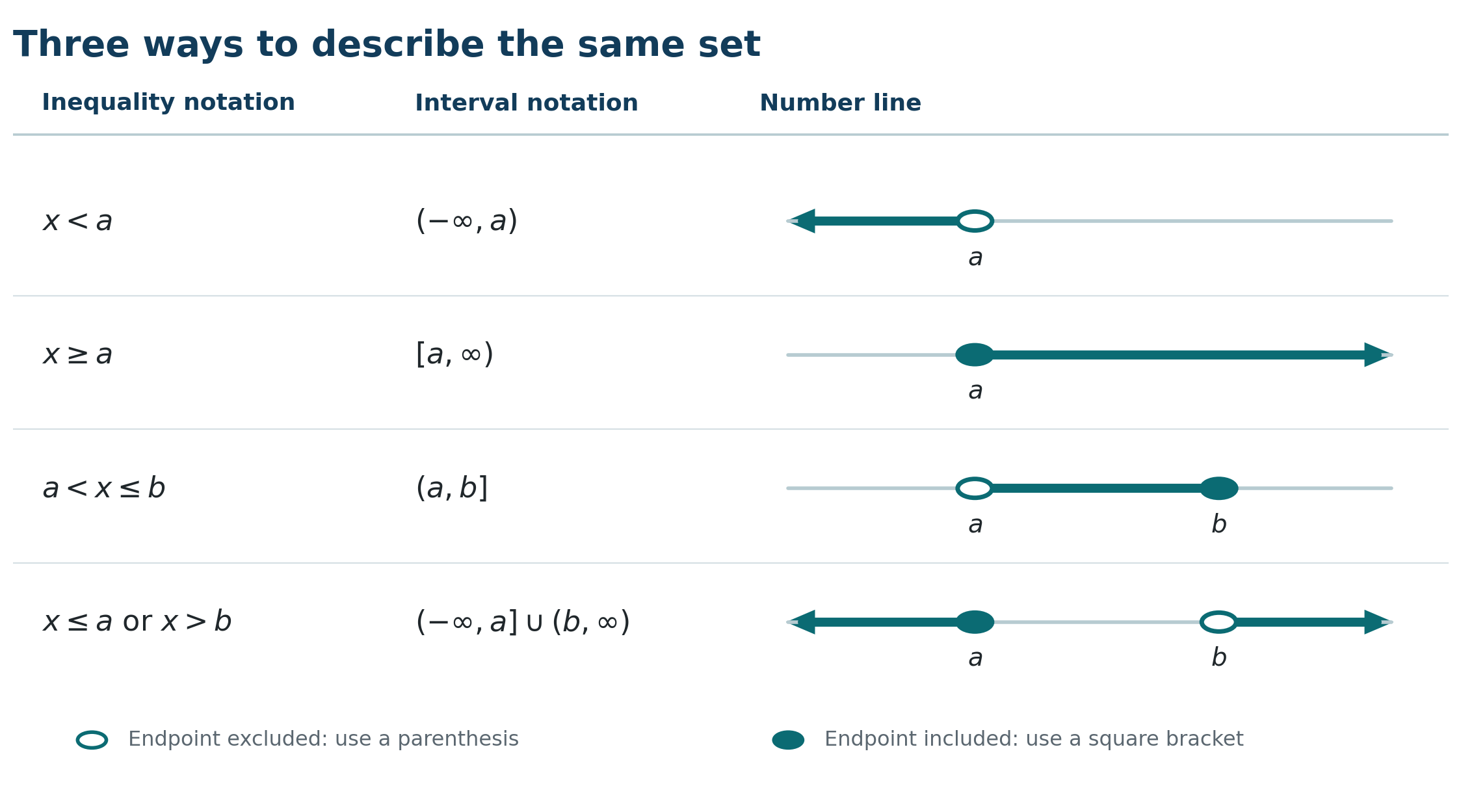
Figure 1.1: Connections among inequality notation, interval notation, and number-line representations.
Worked Example: Converting a chlorine-residual specification
A specification requires a residual greater than 0.20 mg/L but no greater than 0.80 mg/L. If \(C\) is the residual,
\[0.20<C\le0.80,\]
which is \((0.20,0.80]\) in interval notation.
Check Your Work
\([6.5,8.5)\).Applied Problem: Selecting an allowable filter loading rate. A filter is mechanically rated from 4 through 12 m/h. Water-quality conditions require a rate greater than 6 m/h but less than 10 m/h. Write each range in interval notation and determine the allowable intersection.
Check Your Work
The equipment range is \([4,12]\) and the process range is \((6,10)\). Their intersection is \((6,10)\) m/h.1.3.2 Practice Problems
- Write \(x\ge-3\) in interval notation.
Check Your Work
\([-3,\infty)\). - Write \((-4,7)\) as an inequality.
Check Your Work
\(-4<x<7\). - Find \(\{1,2,5\}\cap\{2,3,5\}\).
Check Your Work
\(\{2,5\}\). - Find \(\{1,2\}\cup\{2,4\}\).
Check Your Work
\(\{1,2,4\}\). - A pressure must be below 550 kPa. Express the condition for \(p\).
Check Your Work
\(p<550\), or \((-\infty,550)\) algebraically. - A tank level must satisfy \(2.0\le h\le4.5\) m. Write the interval.
Check Your Work
\([2.0,4.5]\) m. - A pump can provide \([18,44]\) L/s, but a process requires \([25,38]\) L/s. Find the common operating range.
Check Your Work
\([18,44]\cap[25,38]=[25,38]\) L/s. - A turbidity alarm is triggered below 0.1 NTU or above 1.0 NTU. Express the alarm set as a union of intervals.
Check Your Work
\((-\infty,0.1)\cup(1.0,\infty)\).