3.1 Quadratic functions and completing the square
A quadratic function has a parabolic graph whose direction, width, vertex, and intercepts can be read from different algebraic forms.
Quadratic function. A polynomial function \(f(x)=ax^2+bx+c\) with \(a\ne0\).
3.1.1 Vertex form and intercepts
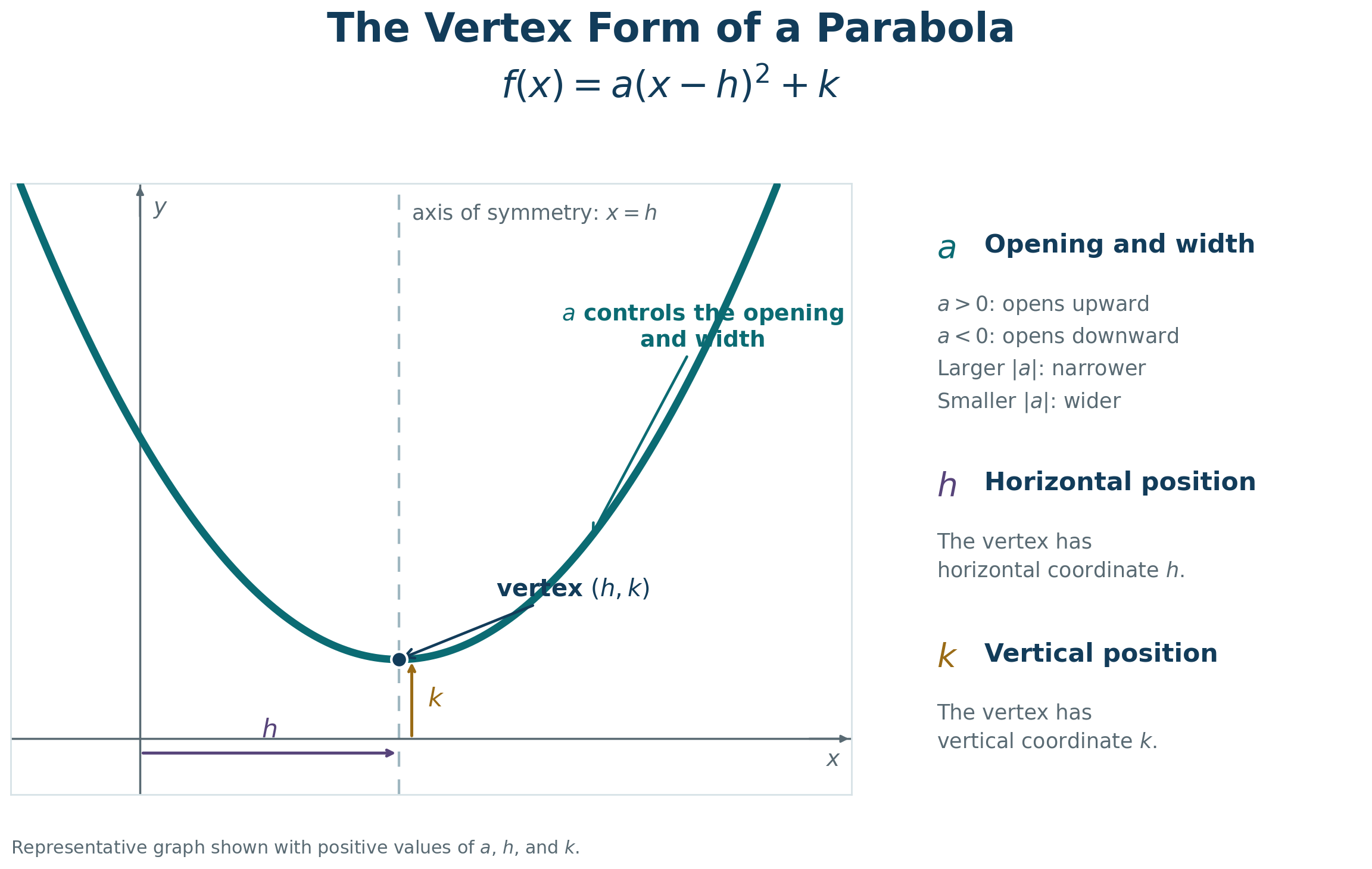
In vertex form, a quadratic has the form:
\[f(x)=a(x-h)^2+k.\]
The vertex is \((h,k)\). The graph opens upward when \(a>0\) and downward when \(a<0\). If \(a>0\), the vertex gives the minimum value \(k\); if \(a<0\), it gives the maximum. The magnitude \(|a|\) controls vertical stretch or compression. Find \(y\)-intercepts by setting \(x=0\) and \(x\)-intercepts by solving \(f(x)=0\).
Worked Example: Graphing from vertex form
For \(f(x)=2(x-2)^2-2\), the vertex is \((2,-2)\) and the parabola opens upward. The \(y\)-intercept is \(f(0)=6\). Solving \(2(x-2)^2-2=0\) gives \(x=1\) and \(x=3\).
Check Your Work
Vertex \((-1,4)\); \(y\)-intercept \((0,3)\); \(x\)-intercepts \((-3,0)\) and \((1,0)\).Worked Example: Interpreting a basin-area parabola
A fixed-perimeter design produces \(A(w)=-w^2+20w\). Factoring gives zeros at 0 and 20, and completing the square gives
\[A(w)=-(w-10)^2+100.\]
The maximum area is 100 m² at width 10 m.
Check Your Work
\(A(x)=-(x-8)^2+64\), so the maximum is 64 at \(x=8\).3.1.2 Completing the square
Completing the square. Rewriting a quadratic by adding and subtracting the value needed to form a perfect-square trinomial.
For \(x^2+bx\), add and subtract \((b/2)^2\):
\[x^2+bx=\left(x+\frac b2\right)^2-\left(\frac b2\right)^2.\]
When \(a\ne1\), first factor \(a\) from the variable terms. The vertex of \(ax^2+bx+c\) occurs at \(h=-b/(2a)\), with \(k=f(h)\).
Worked Example: Completing the square
Rewrite \(x^2+10x+7\):
\[x^2+10x+7=(x+5)^2-25+7=(x+5)^2-18.\]
The vertex is \((-5,-18)\).
Check Your Work
\((x-4)^2-13\).Worked Example: Completing the square with a leading coefficient
For \(2x^2-12x+5\),
\[2(x^2-6x)+5= 2[(x-3)^2-9]+5=2(x-3)^2-13.\]
The vertex is \((3,-13)\).
Check Your Work
\(3(x+2)^2-13\).Applied Problem: Maximizing rectangular channel area. A rectangular channel is built inside a 24 m wide lined cross-section so that its width is \(24-2d\) when its depth is \(d\). Form the area function, rewrite it in vertex form, and find the dimensions that maximize area.
Check Your Work
\(A(d)=d(24-2d)=-2d^2+24d=-2(d-6)^2+72\). The maximum occurs at \(d=6\) m, giving width 12 m and area 72 m².3.1.3 Practice Problems
- State the vertex of \(2(x-4)^2+3\).
Check Your Work
\((4,3)\). - Find the intercepts of \((x-1)^2-9\).
Check Your Work
\(y\)-intercept \((0,-8)\); \(x\)-intercepts \((-2,0)\) and \((4,0)\). - Complete the square for \(x^2+6x-2\).
Check Your Work
\((x+3)^2-11\). - Rewrite \(4x^2-16x+1\) in vertex form.
Check Your Work
\(4(x-2)^2-15\). - Find the maximum or minimum of \(-3(x+2)^2+7\).
Check Your Work
Maximum 7 at \(x=-2\). - A basin-area model is \(A(w)=-w^2+18w\). Find its maximum.
Check Your Work
\(A=-(w-9)^2+81\), so the maximum is 81 m². - A pump index is \(E(q)=-0.5(q-12)^2+40\). State the optimal flow and maximum index.
Check Your Work
Optimal flow 12 units; maximum index 40. - A rectangular enclosure has area \(A(x)=x(30-2x)\). Find the positive dimension that maximizes area.
Check Your Work
\(A=-2(x-7.5)^2+112.5\), so \(x=7.5\).