4.3 Logarithmic functions and laws
Logarithms answer exponent questions and provide the inverse operation needed to solve many exponential equations.
4.3.1 Definition, graph, and domain
Logarithm. For \(b>0\) and \(b\ne1\), \(\log_b(y)=x\) exactly when \(b^x=y\).
The logarithm’s input must be positive. The graph of \(y=\log_bx\) has domain \((0,\infty)\), range \(\mathbb R\), \(x\)-intercept \((1,0)\), and vertical asymptote \(x=0\). It is the reflection of \(y=b^x\) across \(y=x\). Natural logarithm uses base \(e\) and is written \(\ln x\).
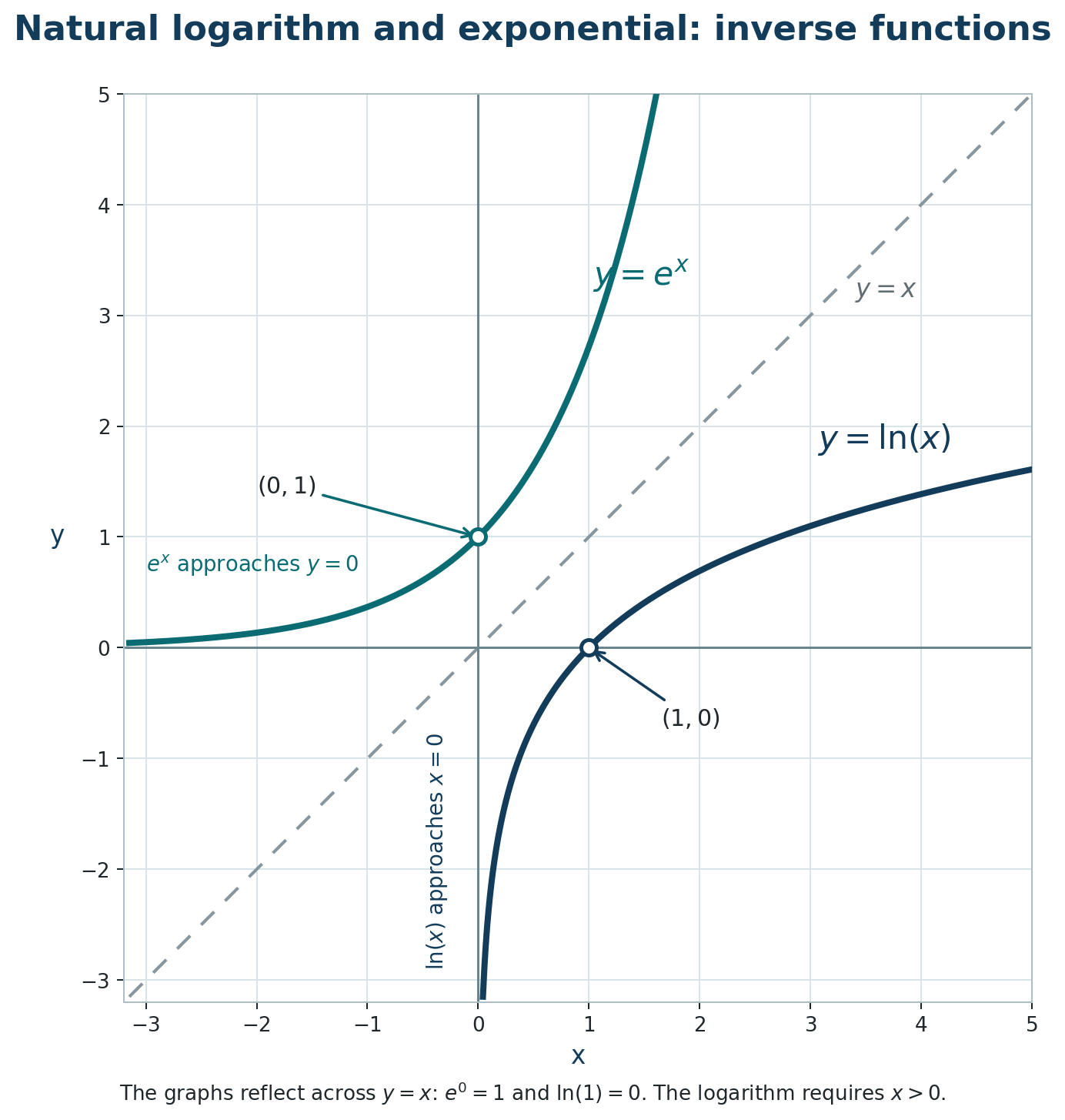
Worked Example: Converting forms
The statement \(4^{1/2}=2\) is equivalent to \(\log_4(2)=1/2\). Likewise, \(\log_3(1/9)=-2\) because \(3^{-2}=1/9\).
Check Your Work
\(\log_5(125)=3\).Worked Example: Finding a logarithmic domain
For \(f(x)=\log_7(9-5x)\), require \(9-5x>0\). Therefore, \(x<9/5\).
Check Your Work
\(3x+12>0\), so \(x>-4\).4.3.2 Product, quotient, and power laws
For positive arguments,
\[\log_b(MN)=\log_bM+\log_bN,\] \[\log_b(M/N)=\log_bM-\log_bN,\] \[\log_b(M^p)=p\log_bM.\]
These laws do not permit splitting a sum or difference inside a logarithm. Domains must be taken from the original expression.
Worked Example: Expanding a logarithm
For positive \(x\) and \(x+1\),
\[\ln\left(\frac{3e^x(x+1)^5}{x^2}\right)=\ln3+x+5\ln(x+1)-2\ln x.\]
Check Your Work
\(3+3\log_2x-\log_2(x-1)\), on the original domain.Worked Example: Combining logarithms
\[3\ln x+2\ln(x+1)-\ln(4x-1)=\ln\left(\frac{x^3(x+1)^2}{4x-1}\right).\]
Check Your Work
\(\log_5[x^2/(x+3)]\).Applied Problem: Determining a pressure parameter. A model gives \(\ln(k)=-21.504\), where \(k\) is measured in Pa\(^{-1}\). Solve for \(k\) and report it in scientific notation.
Check Your Work
Apply the exponential function: \(k=e^{-21.504}\approx4.59\times10^{-10}\) Pa\(^{-1}\).4.3.3 Practice Problems
- Rewrite \(2^{-4}=1/16\) logarithmically.
Check Your Work
\(\log_2(1/16)=-4\). - Evaluate \(\log_{10}(1000)\).
Check Your Work
3. - Find the domain of \(\ln(7-2x)\).
Check Your Work
\(x<7/2\). - Expand \(\ln(x^4/y^2)\).
Check Your Work
\(4\ln x-2\ln y\) for positive \(x,y\). - Combine \(\log x+3\log y\).
Check Your Work
\(\log(xy^3)\). - A water model gives \(\ln k=-8.2\). Find \(k\).
Check Your Work
\(k=e^{-8.2}\approx2.75\times10^{-4}\). - Find the domain of \(\log(12-C)\) for concentration \(C\ge0\).
Check Your Work
\(0\le C<12\). - Expand \(\ln[Q^2/(Q+5)]\) for positive quantities.
Check Your Work
\(2\ln Q-\ln(Q+5)\).