3.3 Rational functions, holes, and asymptotes
Rational functions are ratios of polynomials. Their graphs can contain excluded points and can approach lines that organize their long-term or near-boundary behaviour.
Vertical asymptote. A line \(x=a\) approached by a function whose magnitude grows without bound as \(x\) approaches \(a\) from at least one side.
3.3.1 Domains, holes, and vertical asymptotes
Factor numerator and denominator before interpreting a rational function. Original denominator zeros are excluded from the domain. A factor that cancels produces a hole, not a vertical asymptote. An uncancelled denominator zero produces a vertical asymptote.
Hole. A removable discontinuity created when a common factor cancels but its zero remains excluded from the original domain.
Worked Example: Distinguishing a hole from an asymptote
For
\[r(x)=\frac{x^2-1}{x^2+x-2}=\frac{(x-1)(x+1)}{(x-1)(x+2)}=\frac{x+1}{x+2},\]
the domain excludes \(x=1,-2\). There is a hole at \((1,2/3)\) and a vertical asymptote at \(x=-2\).
Check Your Work
It simplifies to \((x-2)/(x-3)\) with \(x\ne-2,3\). There is a hole at \((-2,4/5)\) and a vertical asymptote at \(x=3\).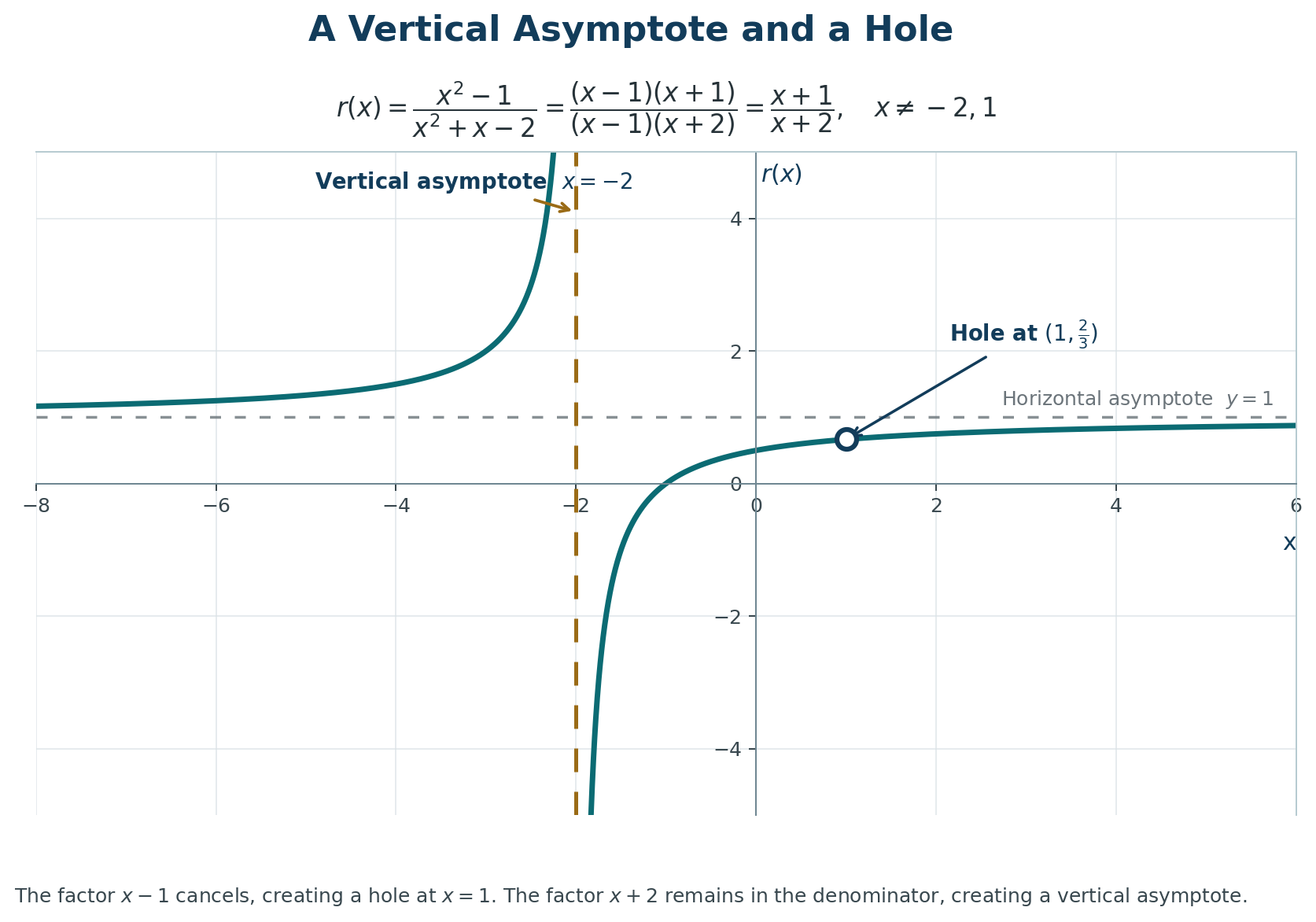
Worked Example: One-sided behaviour near an operating limit
For \(f(q)=1/(q-10)\), \(f(q)\to-\infty\) as \(q\to10^-\) and \(f(q)\to\infty\) as \(q\to10^+\). The line \(q=10\) is a vertical asymptote.
Check Your Work
As \(x\to-4^-\), the function approaches \(-\infty\); as \(x\to-4^+\), it approaches \(\infty\).3.3.2 Horizontal asymptotes
Horizontal asymptote. A line \(y=L\) approached by a function as \(x\to\infty\) or \(x\to-\infty\).
For a rational function with numerator degree \(n\) and denominator degree \(m\): if \(n<m\), the horizontal asymptote is \(y=0\); if \(n=m\), it is the ratio of leading coefficients; if \(n>m\), there is no horizontal asymptote. A graph may cross a horizontal asymptote.
Worked Example: Finding a horizontal asymptote
For \(f(x)=(2x^2+7x-4)/(x^2+x-2)\), numerator and denominator have equal degree. The horizontal asymptote is \(y=2/1=2\).
Check Your Work
\(y=3/2\).Worked Example: Comparing degrees
For \(g(x)=(5x-1)/(x^3+2)\), the numerator degree is less than the denominator degree, so \(g(x)\to0\) as \(x\to\pm\infty\). The horizontal asymptote is \(y=0\).
Check Your Work
No. The numerator degree is greater than the denominator degree.Applied Problem: Interpreting a rational pressure model. A simplified pressure index is \(P(q)=(4q^2-16)/(q^2-q-6)\). Factor the model, state its domain, identify any hole and vertical asymptote, and find the horizontal asymptote.
Check Your Work
\(P(q)=4(q-2)(q+2)/[(q-3)(q+2)]=4(q-2)/(q-3)\), with \(q\ne-2,3\). The hole is at \((-2,16/5)\), the vertical asymptote is \(q=3\), and the horizontal asymptote is \(P=4\).3.3.3 Practice Problems
- State the domain of \((x+1)/(x^2-9)\).
Check Your Work
\(x\ne-3,3\). - Find the hole of \((x^2-4)/(x-2)\).
Check Your Work
Hole at \((2,4)\). - Find the vertical asymptotes of \((x+1)/[(x-2)(x+5)]\).
Check Your Work
\(x=2\) and \(x=-5\). - Find the horizontal asymptote of \((7x^2+1)/(2x^2-3)\).
Check Your Work
\(y=7/2\). - Find the horizontal asymptote of \(4/(x^2+1)\).
Check Your Work
\(y=0\). - A head-loss index is \((q^2-25)/(q-5)\). Identify its hole.
Check Your Work
It simplifies to \(q+5\) with a hole at \((5,10)\). - A pressure model is \(3q/(q-12)\). Identify its vertical and horizontal asymptotes.
Check Your Work
Vertical \(q=12\); horizontal \(P=3\). - A treatment model is \((2q+1)/(q^2-16)\). State the excluded flows.
Check Your Work
\(q\ne-4,4\).