2.3 Graphical behaviour and transformations
Graphs support both qualitative interpretation and numerical problem solving. They show intersections, sign, intervals of increase or decrease, extrema, and the effects of changing a familiar formula.
2.3.1 Graphical equations, inequalities, and extrema
The solutions of \(f(x)=g(x)\) are the \(x\)-coordinates where their graphs intersect. The inequality \(f(x)<g(x)\) holds where the graph of \(f\) lies below the graph of \(g\). Include intersection points only when equality is part of the comparison.
Worked Example: Solving an equation graphically
To solve \(x^2-1=8-x^2\), graph \(y=x^2-1\) and \(y=8-x^2\). Their intersections satisfy \(2x^2=9\), so the intersection inputs are \(x=\pm3/\sqrt2\approx\pm2.12\).
Check Your Work
\(x=-2\) and \(x=2\).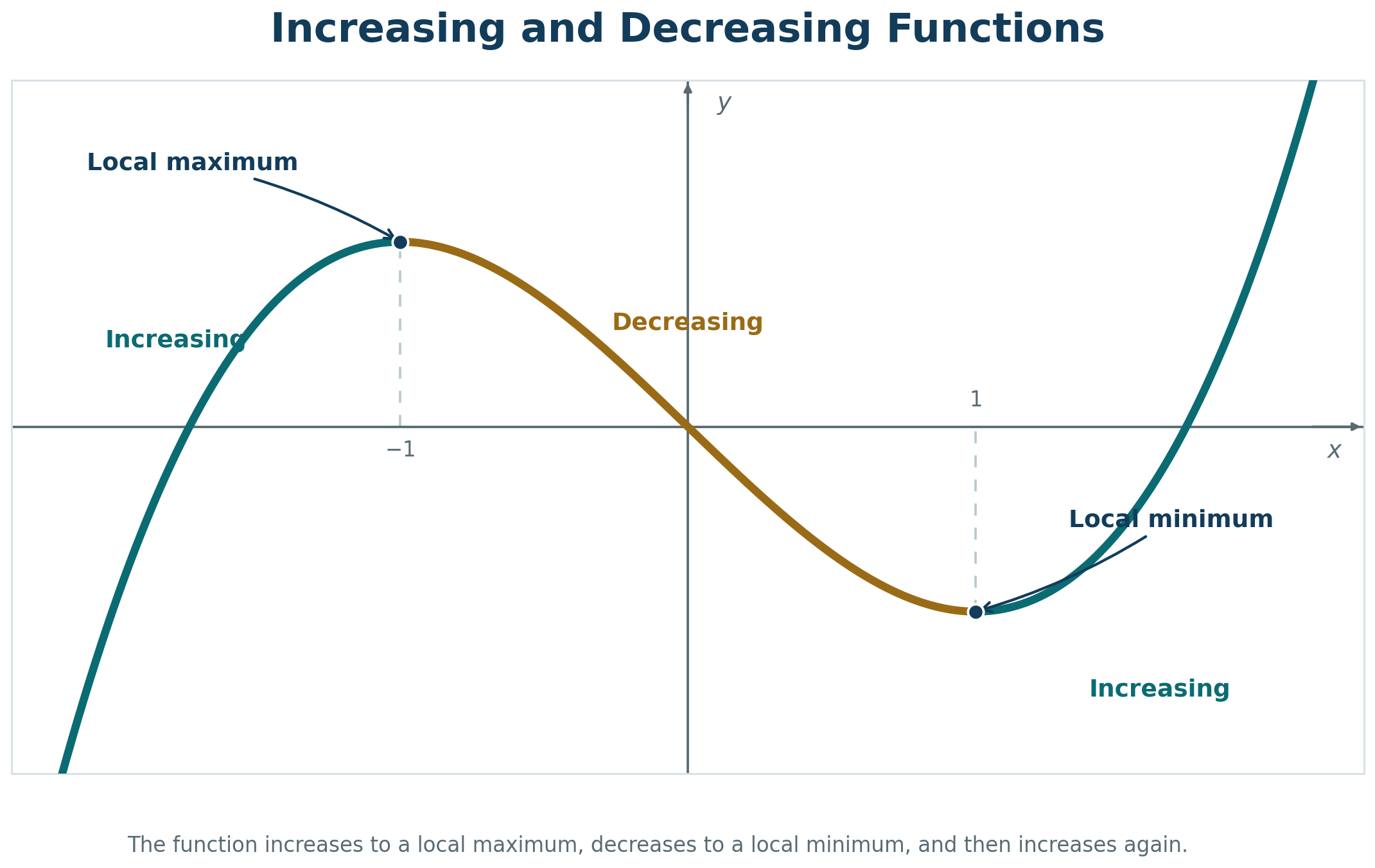
Increasing function. A function whose outputs rise as inputs increase on a specified interval.
Local extremum. A local maximum or minimum value compared with nearby function values.
An interval of increase or decrease is described with input values. A turning point may be a local maximum or minimum. A graph can have several local extrema, and a local extremum need not be the greatest or least value on the entire domain.
Worked Example: Describing a quadratic’s behaviour
For \(f(x)=-(x-3)^2+8\), the vertex \((3,8)\) is a maximum. The function increases on \((-\infty,3)\) and decreases on \((3,\infty)\).
Check Your Work
It decreases on \((-\infty,-1)\) and increases on \((-1,\infty)\).2.3.2 Transforming parent graphs
If \(c>0\), \(f(x)+c\) shifts upward and \(f(x)-c\) shifts downward. The graph of \(f(x-c)\) shifts right, while \(f(x+c)\) shifts left. The graph of \(-f(x)\) reflects across the \(x\)-axis, and \(f(-x)\) reflects across the \(y\)-axis. Multiplying by \(a\) changes vertical scale by \(|a|\) and reflects vertically when \(a<0\). Replacing \(x\) by \(kx\) changes horizontal scale by \(1/|k|\).
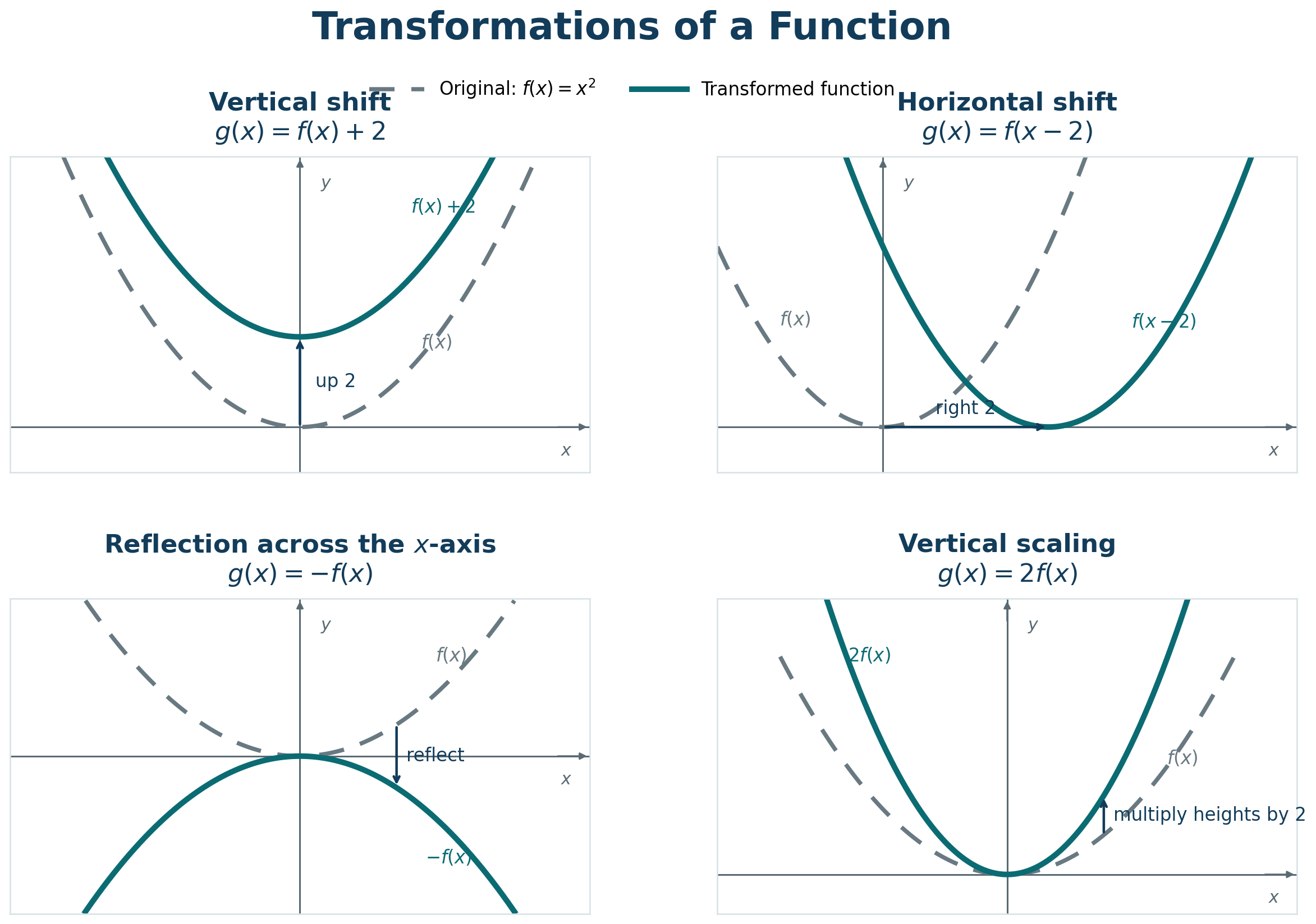
Order matters. Work from inside to outside: horizontal scale, horizontal shift, vertical scale or reflection, then vertical shift. Track a small set of key points rather than producing a new table from scratch.
Worked Example: Transforming a quadratic
The graph of \(y=-3(x+3)^2+2\) comes from \(y=x^2\). Shift left 3, stretch vertically by 3, reflect across the \(x\)-axis, and shift up 2. The vertex is \((-3,2)\) and the parabola opens downward.
Check Your Work
Stretch vertically by 2, shift right 4, and down 1. The vertex is \((4,-1)\).Worked Example: Transforming a square-root model
The graph of \(y=\sqrt{x-3}+2\) is \(y=\sqrt{x}\) shifted right 3 and up 2. Its starting point is \((3,2)\), its domain is \([3,\infty)\), and its range is \([2,\infty)\).
Check Your Work
Starting point \((-1,4)\); domain \([-1,\infty)\); range \((-\infty,4]\).Applied Problem: Interpreting a transformed pump curve. A simplified pump-efficiency index is \(E(q)=-0.02(q-30)^2+18\). Identify the transformation from \(y=x^2\), state the maximum point, and determine the intervals on which efficiency rises and falls.
Check Your Work
The graph is reflected, vertically compressed by 0.02, shifted right 30, and shifted up 18. Its maximum is \((30,18)\). It increases for \(q<30\) and decreases for \(q>30\).2.3.3 Practice Problems
- Solve graphically or algebraically where \(x^2=9\).
Check Your Work
\(x=-3\) or \(x=3\). - Where is \(x^2<4\)?
Check Your Work
\(-2<x<2\). - State the local minimum of \((x-5)^2-2\).
Check Your Work
The minimum value is \(-2\) at \(x=5\). - Describe the transformations from \(|x|\) to \(-2|x+1|+3\).
Check Your Work
Left 1, vertical stretch by 2, reflection across the \(x\)-axis, and up 3. - State the domain and range of \(\sqrt{x+4}-2\).
Check Your Work
Domain \([-4,\infty)\); range \([-2,\infty)\). - A pump curve is \(H(q)=-(q-20)^2+100\). State its maximum and where it decreases.
Check Your Work
Maximum 100 at \(q=20\); decreasing on \((20,\infty)\). - Two pressure models are \(P_1(q)=2q+10\) and \(P_2(q)=70-q\). Find their intersection.
Check Your Work
\(2q+10=70-q\), so \(q=20\) and \(P=50\). - A transformed depth model is \(d(t)=-\sqrt{t-4}+6\). State its initial point and physical range for \(t\ge4\).
Check Your Work
It begins at \((4,6)\). Algebraically the range is \((-\infty,6]\); restricting to nonnegative depth gives \([0,6]\).