1.9 Polynomial division and rational zeros
Higher-degree polynomials require systematic methods for division and for identifying values that make them equal to zero.
Zero of a polynomial. A value \(c\) for which \(P(c)=0\).
Division Algorithm for Polynomials. For polynomials \(P\) and nonzero \(D\), there are unique polynomials \(Q\) and \(R\) such that
\[P(x)=D(x)Q(x)+R(x),\]
where \(R(x)=0\) or the degree of \(R\) is less than the degree of \(D\).
1.9.1 Long and synthetic division
To divide \(6x^2-26x+12\) by \(x-4\), divide leading terms, multiply, subtract, and continue.
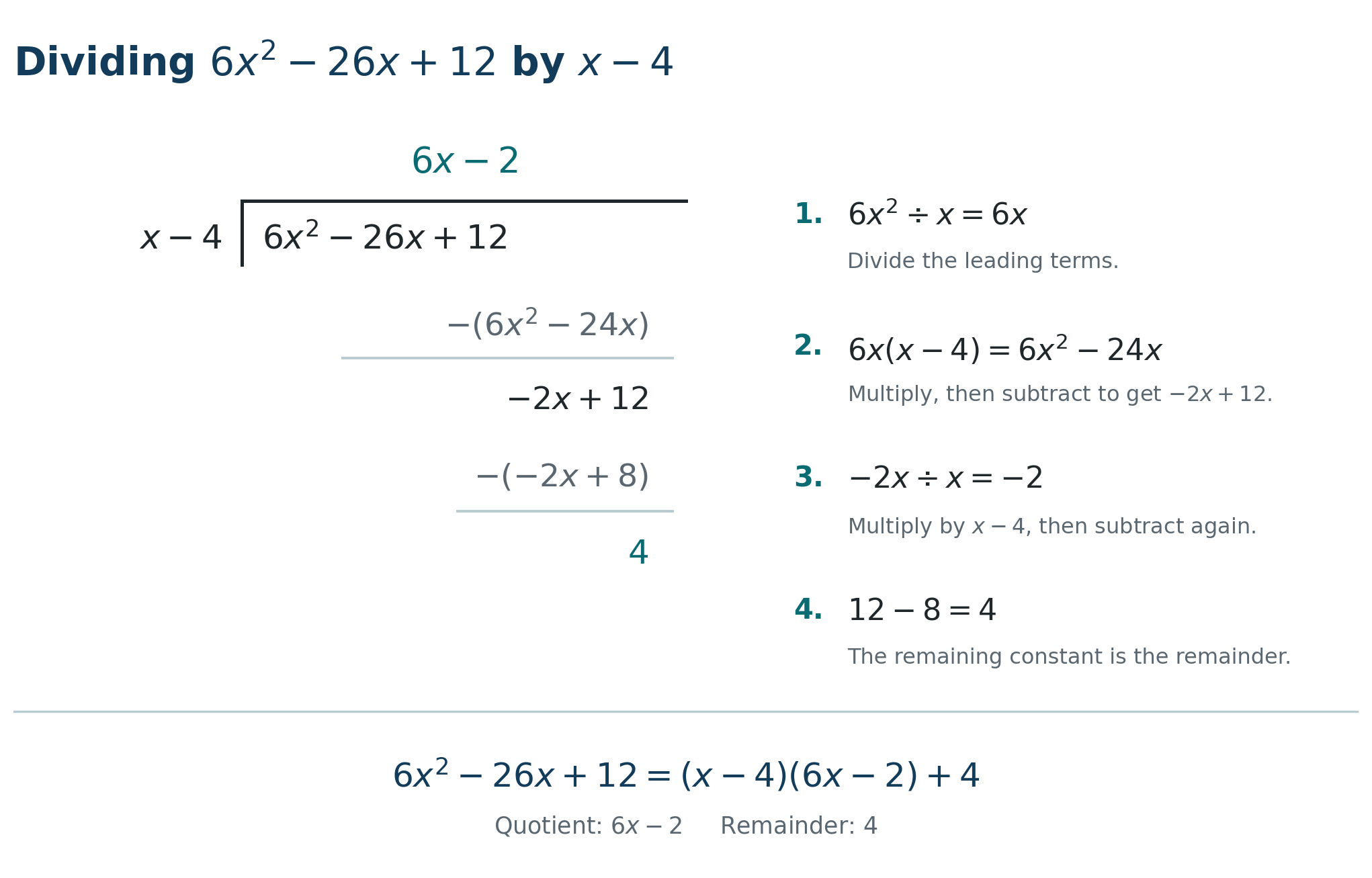
The result from division is
\[\frac{6x^2-26x+12}{x-4} = 6x - 2 + \frac{4}{x-4}.\]
If we multiply through by \(x-4\), we get
\[6x^2-26x+12=(x-4)(6x-2)+4.\]
The quotient is \(6x-2\) and the remainder is 4. Substitution confirms the remainder because \(P(4)=4\).
Remainder Theorem. If a polynomial \(P(x)\) is divided by \(x-c\), the remainder is \(P(c)\).
Worked Example: Applying the Remainder Theorem
For \(P(x)=3x^2-2x+5\), the remainder after division by \(x-2\) is
\[P(2)=3(2)^2-2(2)+5=13.\]
Check Your Work
\(P(-1)=-1-4-1=-6\), so the remainder is \(-6\).Worked Example: Finding a remainder by substitution
For \(P(x)=2x^3-x+4\), division by \(x+1\) has remainder \[P(-1)=2(-1)^3-(-1)+4=3.\]
Check Your Work
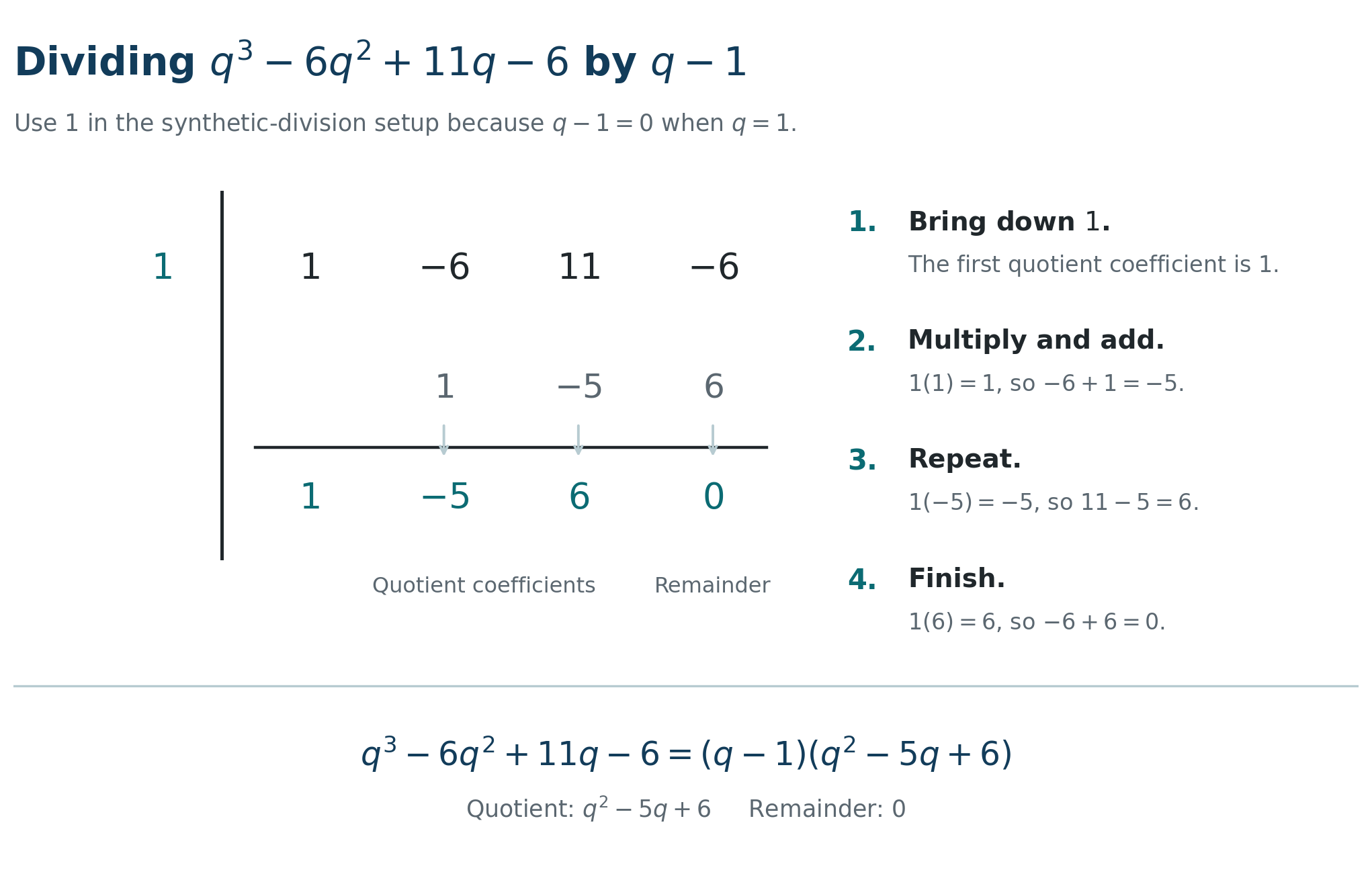
\(P(2)=8+4-5=7\).In synthetic division, include a zero coefficient for every missing power. For \(2x^3-7x^2+5\), use coefficients \(2,-7,0,5\). Omitting the zero shifts later coefficients into incorrect positions.
Worked Example: Dividing a calibration polynomial
Divide \(q^3-6q^2+11q-6\) by \(q-1\). Synthetic division with \(1\) gives quotient \(q^2-5q+6\) and remainder 0:
\[q^3-6q^2+11q-6=(q-1)(q^2-5q+6).\]
Check Your Work
The quotient is \(x^2-3x\) and the remainder is 0.The division algorithm tells us that \[P(x) = D(x)Q(x) + R(x).\] If \(P(x)\) is divisible by \(D(x) = x-c\), then \(\frac{P(x)}{x-c} = Q(x)\) and \(\frac{R(x)}{D(x)} = 0\) meaning that \(R(x) = 0\). The factor theorem says that if \(P(x)\) is divided by \(D(x) = x-c\), that the remainder is \(P(c) = R(c) = 0\). Thus, if \(P(x)\) is divisible by \(x-c\), then \(P(c) = 0\).
Factor Theorem. The expression \(x-c\) is a factor of \(P(x)\) if and only if \(P(c)=0\).
Worked Example: Testing a proposed factor
For \(P(x)=x^3-4x^2+x+6\),
\[P(2)=8-16+2+6=0.\]
Therefore, \(x-2\) is a factor.
Check Your Work
\(P(-1)=-1+2+1-2=0\), so \(x+1\) is a factor.1.9.2 Finding all rational zeros
The Factor Theorem gives us a way to find a factor of a polynomial if we know the zeros of a polynomial. How do we get a list of possible zeros of the polynomial?
Rational Zeros Theorem. If \(P(x)=a_nx^n+\cdots+a_1x+a_0\) has integer coefficients and \(p/q\) is a rational zero in lowest terms, then \(p\) is a factor of \(a_0\) and \(q\) is a factor of \(a_n\).
To use the Rational Zeros Theorem to find roots of a polynomial, create the full candidate list, test candidates until one gives remainder zero, divide out the confirmed factor, and repeat. Finish when the remaining quotient is quadratic or factors directly. Finally, multiply the factors to confirm the original polynomial.
For \(2x^4+3x^3-12x^2-7x+6\), the Rational Zeros Theorem limits the search to ratios formed from factors of 6 in the numerator and factors of 2 in the denominator. This list is (including repeated fractions): \[\text{Denominators of 1: } \qquad \pm \frac{6}{1}, \pm \frac{3}{1}, \pm \frac{2}{1}, \pm \frac{1}{1},\] \[\text{Denominators of 2: } \qquad \pm \frac{6}{2}, \pm \frac{3}{2}, \pm \frac{2}{2}, \pm \frac{1}{2},\] Testing a candidate with synthetic division both checks the zero and produces a lower-degree quotient. Repeating the process turns a fourth-degree factorization into smaller problems. The final factors should be multiplied to verify the coefficients.
A zero, a factor, and an intercept express related facts. If \(P(c)=0\), then \(c\) is a zero, \(x-c\) is a factor, and \((c,0)\) is an \(x\)-intercept of the graph.
Worked Example: Factoring with the Factor Theorem
For \(P(x)=x^3-7x+6\), \(P(1)=0\), so \(x-1\) is a factor. Division and further factoring give
\[P(x)=(x-1)(x+3)(x-2).\]
The zeros are \(-3\), 1, and 2.
Check Your Work
\(P(2)=8-16+2+6=0\), so the Factor Theorem confirms it.Worked Example: Finding all rational zeros of a cubic
For \(P(x)=x^3-2x^2-5x+6\), testing the rational candidates shows \(P(1)=0\). Dividing by \(x-1\) gives \(x^2-x-6=(x-3)(x+2)\). Therefore,
\[P(x)=(x-1)(x-3)(x+2),\]
and the rational zeros are \(-2\), 1, and 3.
Check Your Work
Grouping gives \((x-1)(x^2-4)=(x-1)(x-2)(x+2)\). The zeros are \(-2\), 1, and 2.Applied Problem: Checking a polynomial sensor model. A dimensionless sensor correction is modelled by \(P(x)=x^3-4x^2+x+6\). Determine whether settings \(x=-1\), \(x=2\), and \(x=3\) make the correction zero. Use the results to factor \(P(x)\) completely.
Check Your Work
\(P(-1)=0\), \(P(2)=0\), and \(P(3)=0\), so all three settings are zeros. The factorization is \(P(x)=(x+1)(x-2)(x-3)\).1.9.3 Practice Problems
- Find the remainder when \(x^2+3x+1\) is divided by \(x-1\).
Check Your Work
\(P(1)=5\). - Is \(x+2\) a factor of \(x^3+3x^2-4\)?
Check Your Work
Yes, because \(P(-2)=0\). - List possible rational zeros of \(2x^2-5x+2\).
Check Your Work
\(\pm1,\pm2,\pm1/2\). - Factor \(x^3-4x^2-x+4\).
Check Your Work
\((x-4)(x-1)(x+1)\). - Divide \(x^2-5x+6\) by \(x-2\).
Check Your Work
Quotient \(x-3\), remainder 0. - For a calibration polynomial \(P(q)=q^3-4q+3\), find the remainder after division by \(q-1\).
Check Your Work
\(P(1)=1-4+3=0\), so the remainder is 0. - Determine whether \(q-3\) is a factor of \(P(q)=q^3-5q^2+3q+9\).
Check Your Work
\(P(3)=27-45+9+9=0\), so \(q-3\) is a factor. - A process model is \(P(x)=x^3-6x^2+11x-6\). Factor it and list the settings that make \(P(x)=0\).
Check Your Work
\(P(x)=(x-1)(x-2)(x-3)\), so the settings are 1, 2, and 3.