2.2 Parent functions, piecewise models, and rates of change
Familiar parent graphs make it possible to recognize new functions quickly. Piecewise models allow different rules on different intervals, while rates of change measure how output responds as input changes.
2.2.1 Parent functions and piecewise definitions
Parent function. A basic function whose graph provides a starting shape for a family of related functions.
Important parent functions include constant and linear functions, powers such as \(x^2\) and \(x^3\), roots such as \(\sqrt{x}\) and \(\sqrt[3]{x}\), reciprocal functions such as \(1/x\) and \(1/x^2\), and the absolute-value function \(|x|\). For each, know the general shape, domain, range, intercepts, symmetry, and asymptotes.
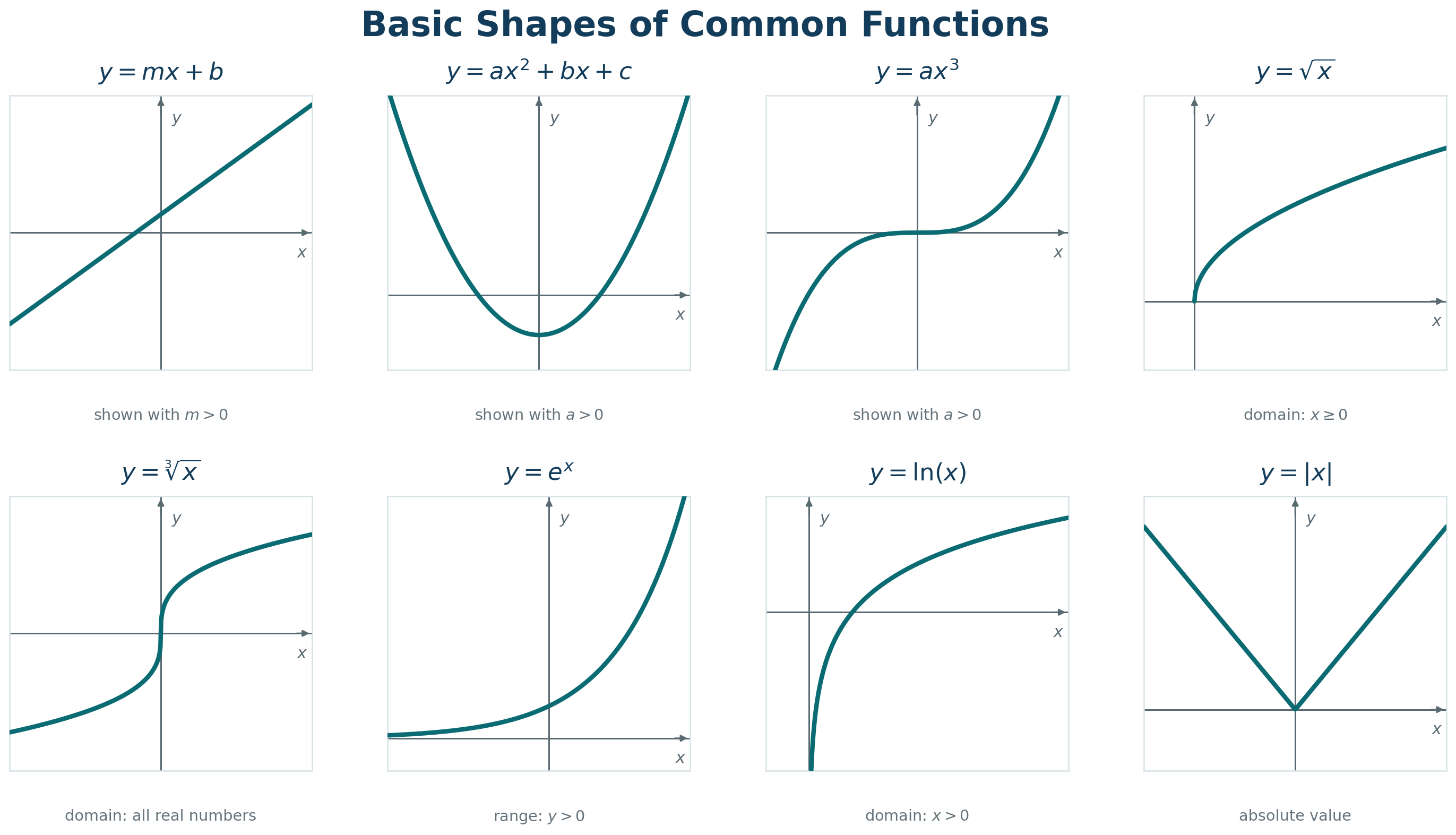
Worked Example: Recognizing an absolute-value response
The function \(E(x)=|x-7|\) measures distance from the target 7. Its graph is V-shaped, has vertex \((7,0)\), domain \(\mathbb R\), and range \([0,\infty)\).
Check Your Work
The vertex is \((-3,0)\) and the range is \([0,\infty)\).A piecewise function uses different rules on different parts of its domain. Endpoint symbols determine which rule applies. A solid point represents an included endpoint, while an open point represents an excluded endpoint. Evaluate a boundary input using the rule whose condition includes equality.
Worked Example: Evaluating a piecewise pump rule
Let
\[P(t)=\begin{cases}12t,&0\le t<5,\\60+8(t-5),&t\ge5.\end{cases}\]
Then \(P(4)=48\) and \(P(5)=60\). The second rule is used at \(t=5\) because it includes equality.
Check Your Work
\(P(7)=60+8(7-5)=76\).2.2.2 Net change, average rate of change, and difference quotients
Average rate of change. The ratio of net output change to input change over an interval.
Between inputs \(a\) and \(b\), net change is \(f(b)-f(a)\) and average rate of change is
\[\frac{f(b)-f(a)}{b-a}.\]
Its units are output units per input unit.
Worked Example: Finding an average inflow rate
A reservoir contains 42 ML at hour 2 and 57 ML at hour 7. The net change is \(57-42=15\) ML, and the average rate is
\[\frac{57-42}{7-2}=3\ \text{ML/h}.\]
Check Your Work
\((30-18)/(10-4)=2\) m³/min.For inputs \(a\) and \(a+h\), the average value becomes the difference quotient
\[\frac{f(a+h)-f(a)}{h},\qquad h\ne0.\]
For a linear function, the average rate of change is constant and equals its slope. For nonlinear functions, it depends on the interval.
Worked Example: Simplifying a difference quotient
For \(f(x)=x-3x^2\),
\[\frac{f(2+h)-f(2)}h=\frac{-11h-3h^2}{h}=-11-3h,\qquad h\ne0.\]
Check Your Work
\([(1+h)^2-1]/h=(2h+h^2)/h=2+h\), \(h\ne0\).Applied Problem: Comparing filtration rates. Cumulative filtered volume is 18 m³ after 30 min and 52 m³ after 80 min. Find the net change and average filtration rate. If the rate were constant, estimate the additional volume filtered during the next 25 min.
Check Your Work
The net change is 34 m³. The average rate is \(34/(80-30)=0.68\) m³/min. At that rate, the next 25 min would add \(0.68(25)=17\) m³.2.2.3 Practice Problems
- State the domain and range of \(y=\sqrt{x}\).
Check Your Work
Both are \([0,\infty)\). - State the domain and range of \(y=1/x\).
Check Your Work
Both are \((-\infty,0)\cup(0,\infty)\). - For \(f(x)=x+2\) when \(x<1\) and \(f(x)=3x\) when \(x\ge1\), find \(f(1)\).
Check Your Work
\(f(1)=3\). - Find the average rate of change of \(x^2\) from \(x=1\) to \(x=5\).
Check Your Work
\((25-1)/(5-1)=6\). - Simplify \([(x+h)^2-x^2]/h\).
Check Your Work
\(2x+h\), \(h\ne0\). - Tank volume rises from 9 m³ at 3 min to 33 m³ at 15 min. Find the average rate.
Check Your Work
\((33-9)/(15-3)=2\) m³/min. - A two-stage pump delivers \(10t\) L for \(0\le t<4\) and \(40+6(t-4)\) L for \(t\ge4\). Find the volume at 3 min and 7 min.
Check Your Work
\(P(3)=30\) L and \(P(7)=58\) L. - Concentration changes from 1.8 mg/L at 10 min to 1.2 mg/L at 25 min. Find and interpret the average rate.
Check Your Work
\((1.2-1.8)/(25-10)=-0.04\) mg/L per min. Concentration decreases by 0.04 mg/L per minute on average.