Chapter 6 Probability and Distributions
Probability is the study of uncertainty — it allows us to measure and reason about the likelihood of events. Probability can be interpreted in two complementary ways:
- As the fraction of times an event occurs in repeated experiments.
- As a degree of belief in the occurrence of an event.
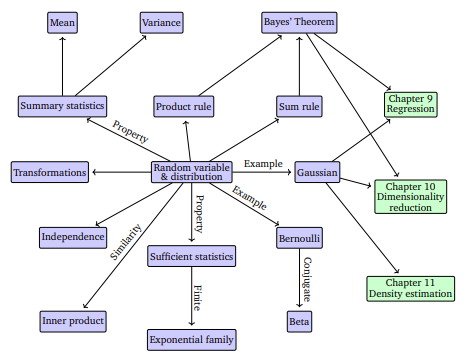
In machine learning, probability helps us quantify uncertainty in:
- The data we collect,
- The models we build, and
- The predictions those models make.
Definition 6.1 A random variable is a function that maps outcomes of a random experiment
to numerical or categorical values that we care about.
Formally, the idea of a random variable connects:
- The sample space (possible outcomes),
- The events (collections of outcomes),
- And the probability distribution, which assigns a likelihood to each outcome or set of outcomes.
Example 6.1 Consider the simple experiment of rolling a fair six-sided die once.
The sample space \(\Omega\) is the set of all possible outcomes: \[ \Omega = \{1, 2, 3, 4, 5, 6\}. \] Each element of \(\Omega\) is a possible outcome of the experiment.
An event is any subset of the sample space. Some examples include:
- Event \(A\): “Roll an even number” \[ A = \{2, 4, 6\}. \]
- Event \(B\): “Roll a number greater than 4” \[ B = \{5, 6\}. \]
A random variable \(X\) is defined as a function: \[ X : \Omega \to \mathbb{R}. \] For example, we could let \[ X(\omega) = \begin{cases} 1, & \text{if } \omega \text{ is even} \\ 0, & \text{if } \omega \text{ is odd} \end{cases}. \] So:
- \(X(2) = 1\), \(X(4) = 1\), \(X(6) = 1\)
- \(X(1) = 0\), \(X(3) = 0\), \(X(5) = 0\)
The random variable turns outcomes into numbers.
Since the die is fair, each outcome has probability: \[ P(\{\omega\}) = \frac{1}{6}, \quad \omega \in \Omega. \] The probability distribution of \(X\) assigns probabilities to the values of \(X\): \[ P(X = 1) = P(\{2,4,6\}) = \frac{3}{6} = \frac{1}{2}, \] \[ P(X = 0) = P(\{1,3,5\}) = \frac{3}{6} = \frac{1}{2}. \] Thus, the distribution of \(X\) is: \[ X = \begin{cases} 1 & \text{with probability } \tfrac{1}{2}, \\ 0 & \text{with probability } \tfrac{1}{2}. \end{cases} \]
Big Picture Connection
- Sample space: all possible outcomes (\(\Omega\))
- Events: subsets of outcomes
- Random variable: a function mapping outcomes to numbers
- Probability distribution: probabilities assigned to the values of the random variable.
Definition 6.2 A probability distribution describes how probabilities are spread over the possible values of a random variable.
Probability distributions tell us the chance that specific outcomes will occur. Distributions are foundational tools for:
- Probabilistic modeling,
- Graphical models,
- Model selection, and
- Inference.
Definition 6.3 A probability space consists of three key elements:
- Sample space – the set of all possible outcomes
- Events – subsets of the sample space
- Probability function – assigns a number between 0 and 1 to each event
These components work together to define how probability is assigned and interpreted.